The Trap in the Two-State Deal

17 Oct 2026 · @Hannan Lis
The question nobody asks
Every plan for a Palestinian state answers the same questions. Borders. Jerusalem. Refugees. Settlements. None of them answers the one that decides whether the deal lives: who signs it, and what happens when the signer loses.
Run the thought experiment honestly. Israel agrees. A Palestinian state is declared between the Jordan River and the 1967 line, with land swaps, a capital in East Jerusalem, international guarantees, the whole package. The ceremony is on the White House lawn. Then the clock starts.
The question is not whether the agreement is fair. It is whether it can survive the next Palestinian election. On the evidence, it cannot.
Who signs, and whether they survive
The regime that signs will not be chosen by Palestinians. It will be the Palestinian Authority or its successor: a Fatah-type leadership kept in power by Israeli intelligence coordination, Gulf money, and the absence of elections. That is not a cynical reading. It is a description of the only Palestinian government that has ever held a negotiated agreement for more than a year.
Can such a regime last? Yes. Mahmoud Abbas has governed for two decades on exactly that formula, without a mandate since 2006. Authoritarian clients survive. What they cannot do is win a vote, and what they cannot deliver is legitimacy.
The real threat to the signer is not the ballot box. It is the bullet. Anwar Sadat signed and was assassinated. Yitzhak Rabin signed and was assassinated. Yasser Arafat signed and had to run two parallel security services to survive his own rejectionists. No Palestinian leader has ever sold a compromise to his own public and lived politically. Arafat walked away from Camp David in 2000. Abbas never answered Ehud Olmert's offer in 2008. Both understood the price of yes.
So the signing regime survives as a client, not as a government. The deal buys a regime. It does not buy a political settlement. And a state whose government cannot face its own voters is a state waiting for the day it has to.
The election nobody can prevent
Sooner or later, a sovereign state holds elections. Washington will insist on it. Brussels will fund it. The Palestinian public will demand it. A state that never votes is not the state anyone signed up to recognize.
When it votes, a Hamas-type victory is not a tail risk. It is the base case. Hamas won in 2006 with 44 percent against a divided Fatah. Palestinian polling since October 7 has been worse for Fatah, not better. Support for armed struggle rose. Hamas's standing in the West Bank has repeatedly exceeded the PA's. Majorities tell pollsters a two-state solution is no longer practical, and most reject the Jewish-state framing outright.
The standard answer is that elections can be managed: candidates vetted, Hamas barred, the vote postponed. Every one of those measures has already been tried in the West Bank. The result is a regime with less legitimacy each year and an opposition that gains it. You cannot build a state on the promise of democracy and then run it on the suppression of the party most Palestinians would vote for. Eventually the pressure wins. It always has.
The morning after
Say it happens in year five or year ten. A Hamas-type movement wins a majority in a sovereign Palestinian state. Three things follow, in order.
The deal dies without being torn up. A Hamas government will not repudiate the treaty on day one. It will announce that it respects international obligations while declining to recognize Israel, exactly as it did in 2006. Enforcement simply stops. Militias are not disarmed. Rocket fire is not prevented. The border is not controlled. Nothing is formally breached, and everything is.
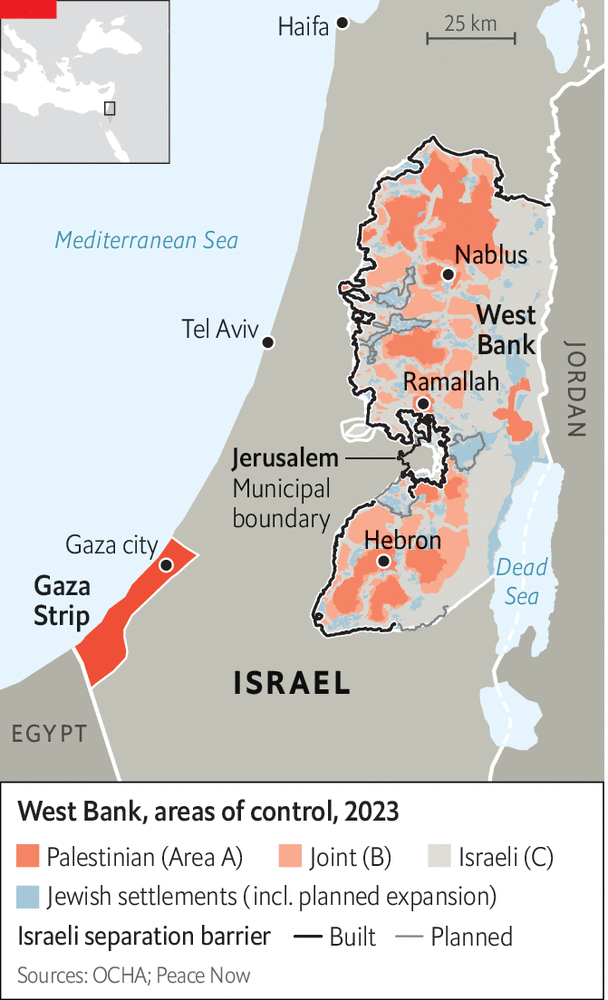
Israel reoccupies, but now as the invader of a sovereign state. In 2002 Israel re-entered Area A cities against a non-state authority. Five years into a treaty, the same operation is an act of war against a UN member state. It comes with an ICJ case, a Security Council vote, and an arms-embargo debate in every Western parliament. Israel's freedom of action is worse than it is today, not better. The agreement that was supposed to secure Israel has handed its enemy sovereign immunity.
The guarantors walk. Washington calls it an internal Palestinian matter. Europe calls Israel the party in breach. The Gulf states freeze. The economic scaffolding that made the deal possible evaporates inside a year. The international community that pressed Israel to sign discovers it has no mechanism, and no appetite, to enforce what it demanded.
None of this requires bad faith from anyone. It requires only that each actor do what it has already done once.
We have run this experiment twice
This is not speculation. Israel has withdrawn to a recognized line twice in a generation, and both times the vacuum was filled by a movement that captured the territory from within.
Gaza, 2005 to 2007. Israel left every settlement and every soldier. Elections followed. Hamas won, then seized the strip by force. The result was eighteen years of war, four major operations, October 7, and the destruction of Gaza. A sovereign Palestinian state would be Gaza with a UN seat and a flag that the invader has to lower.
Lebanon, 2000. Israel withdrew to a UN-certified border. Hezbollah declared victory, built a state within a state, and no international mechanism, not UNIFIL, not Resolution 1701, ever disarmed it. Twenty-four years later Israel had to fight its way back in.
Neither case has a version that ends well. Both were sold at the time as the responsible move. Both produced the opposite of what their advocates promised. Anyone proposing a third withdrawal owes an explanation of what is different this time. Nobody has offered one.
The trap
If the deal has to survive a Hamas election, its design is dictated in advance. Israeli security control of the Jordan Valley and the airspace, indefinitely. A demilitarization regime with Israeli enforcement rights written into the treaty. Staged sovereignty that reverses on breach. A standing Israeli declaration that a rejectionist electoral victory is itself a casus belli.
Every one of those terms is necessary. And every one of them means the state is sovereign on paper and conditional in practice. That is the Oslo interim arrangement with a flag. The Palestinians rejected that version once, and no Palestinian signatory can accept it now without becoming the client regime described above. No international guarantor will underwrite it, because it looks like occupation with extra steps.
So the trap closes. A deal strong enough to survive a Hamas election is not a state. A state real enough to be called one cannot survive a Hamas election. The two-state solution, as currently imagined, requires both at once.
What a serious conversation would look like
None of this means the status quo is sustainable or that Palestinians will stop being a people. They will not become Jordanians, and Jordan does not want them. The question is not whether Palestinians govern themselves. It is what form of self-government can coexist with a Jewish state next door, and the honest answer is not the one in the diplomatic cables.
Israel's actual peace partners are Egypt and Jordan: authoritarian states that keep a cold peace because their rulers have more to lose from war than from their own Islamists. That is the only model in the region that has held for forty years. It is not consensual democracy, and it does not pretend to be.
The serious conversation starts there. Confederation with Jordan. A Gaza trusteeship with Arab forces and Israeli enforcement rights. Staged autonomy that expands with performance and contracts on breach. Each has thinkers behind it and none has a constituency ready to pay for it. But all of them share one virtue the two-state orthodoxy lacks: they do not depend on a Palestinian election going the right way.
The two-state solution survives as the thing everyone can say out loud. It does not survive contact with the ballot box. Until its advocates can answer what happens in year five, they are not proposing a solution. They are proposing a ceremony.
Comments